
TL;DR (Overview)
GoodSpace reimagines hiring by replacing manual filtering with AI-driven shortlisting and interviews. By improving match quality and reducing uncertainty in the hiring journey, the platform reduced overall hiring time by 47%, decreased drop-offs by 12%, and increased application engagement by 8%.
- ROLE
- Product Designer
- TIMELINE
- 2023-2024
- TEAM
- Naman Bhateja
- Skills
- User researchUIUX DesignPrototyping
Problem
Hiring today is not broken because of lack of opportunities, it’s broken because of poor signal quality.
Job seekers are overwhelmed with irrelevant listings, often applying to roles that don’t match their skills. At the same time, recruiters are flooded with applications, spending hours filtering candidates who aren’t a good fit.
For Job Seekers
- 45% struggle to find relevant jobs
- 54% are frustrated by long application processes
- 40% waste time applying to mismatched roles
For Recruiters
- 63% spend significant time filtering unqualified applicants
- 52% believe platforms fail to filter effectively
- 60% candidate drop-off during interviews
This leads to:
- Low-quality matches
- Delayed hiring cycles
- Poor user trust
Context
GoodSpace operates in a highly competitive ecosystem:
- Naukri
- Indeed
- Glassdoor
These platforms:
- Rely on manual filtering or keyword matching
- Lack AI-driven evaluation systems
- Provide minimal feedback loops
Constraints
- Low trust in AI decisions
- High drop-offs in long hiring flows
- Need to balance automation vs control
Opportunity: Replace resume-heavy workflows with AI-driven decision systems
Research & Insights
Through secondary research and product understanding, a few patterns became clear.
Job seekers were not struggling to find jobs, they were struggling to find the right jobs. Nearly half of users reported difficulty identifying relevant roles, and a large portion admitted applying to mismatched positions.
At the same time, recruiters were overwhelmed. A majority reported spending significant time filtering applications, many of which were underqualified.
Another major gap was lack of feedback. Most users never received updates after applying, which reduced trust and increased drop-offs.
From this, a key pattern emerged:
- Volume of applications was high
- Quality of matches was low
- Feedback loops were almost non-existent
Key Insights
Instead of treating hiring as a pipeline, it became clear that it behaves more like a decision system.
- Users need relevance, not more options
- Recruiters need signal filtering, not more data
- Feedback builds trust in automated systems
- Reducing uncertainty improves completion rates
Key Decisions & Tradeoffs
To address these issues, we focused on improving signal quality across the journey — even if it meant introducing complexity in certain areas.
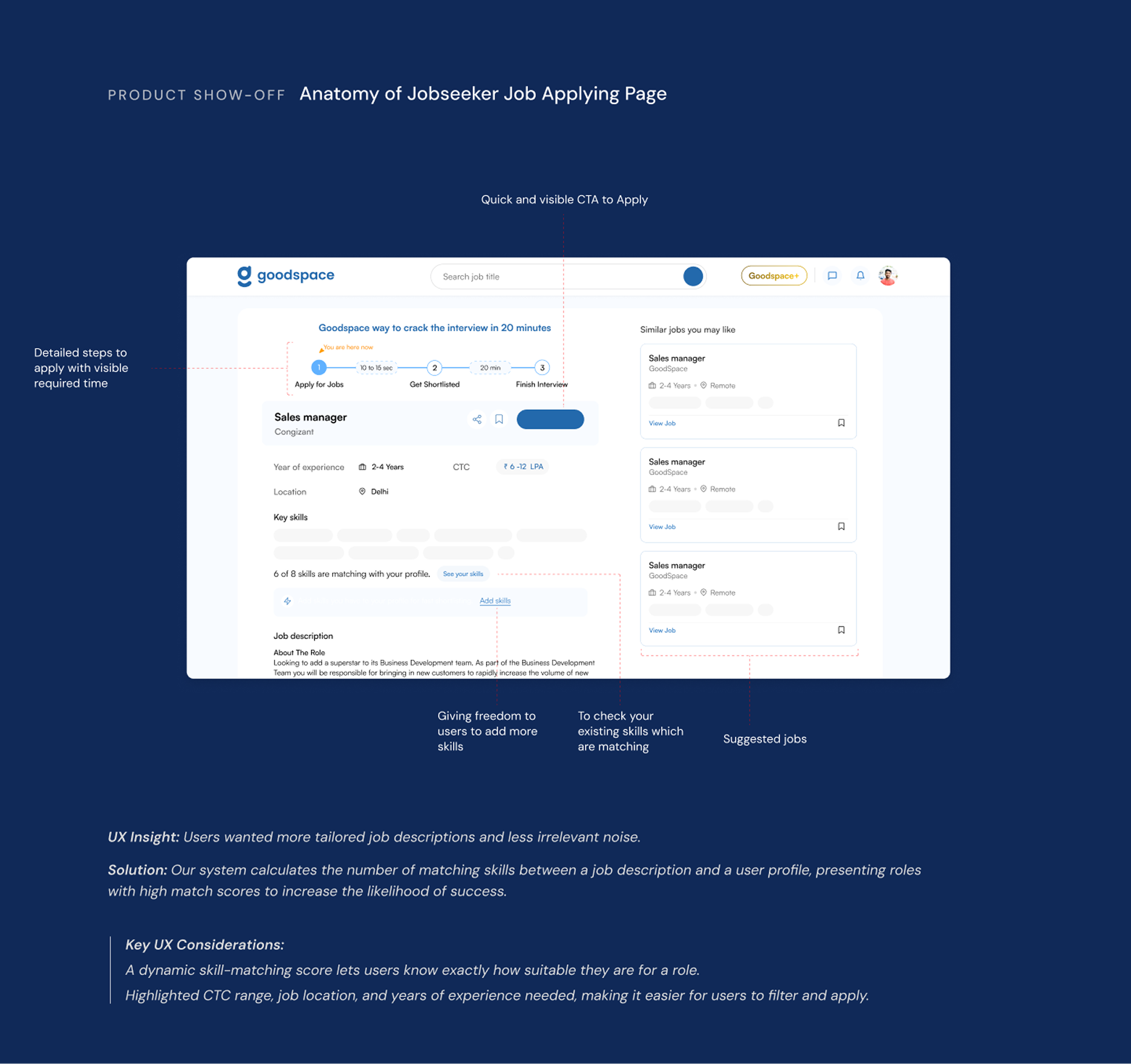
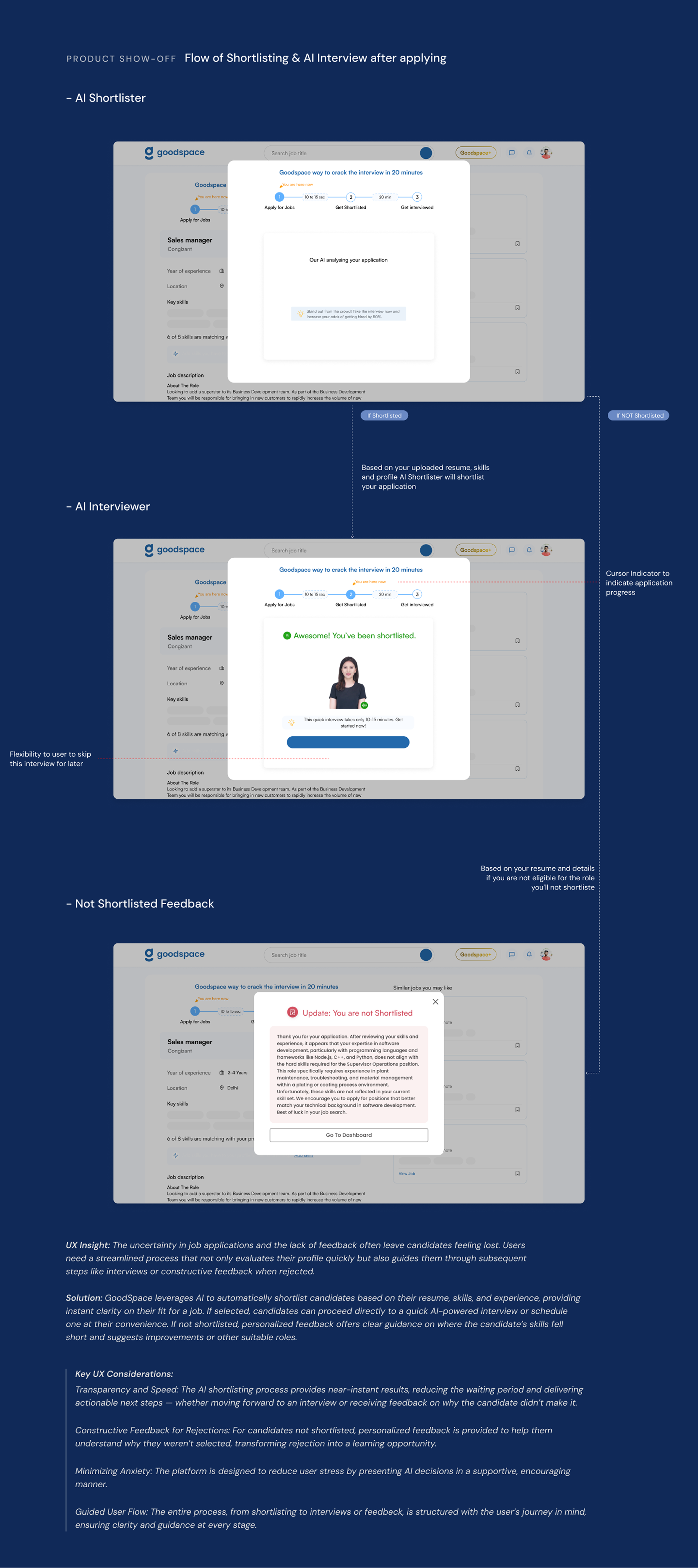
One of the biggest decisions was introducing AI-based shortlisting. While this significantly reduced recruiter effort, it also introduced a trust problem. To balance this, we exposed signals like skill match scores and application status, helping users understand how decisions were made.
Another key decision was enabling instant AI interviews. This reduced hiring time drastically, but we noticed users felt pressured. To address this, we added flexibility by allowing users to reschedule interviews, balancing speed with comfort.
We also moved away from traditional keyword matching and introduced skill-based matching. Instead of simply matching resumes to job descriptions, we focused on how well a candidate’s skills aligned with the role.
Across all decisions, one principle remained consistent:
Automation should reduce effort, not reduce clarity
Solution
The hiring experience was redesigned into a structured, three-stage system — each stage improving signal quality and reducing friction.
1. Discovery → Finding Relevant Jobs
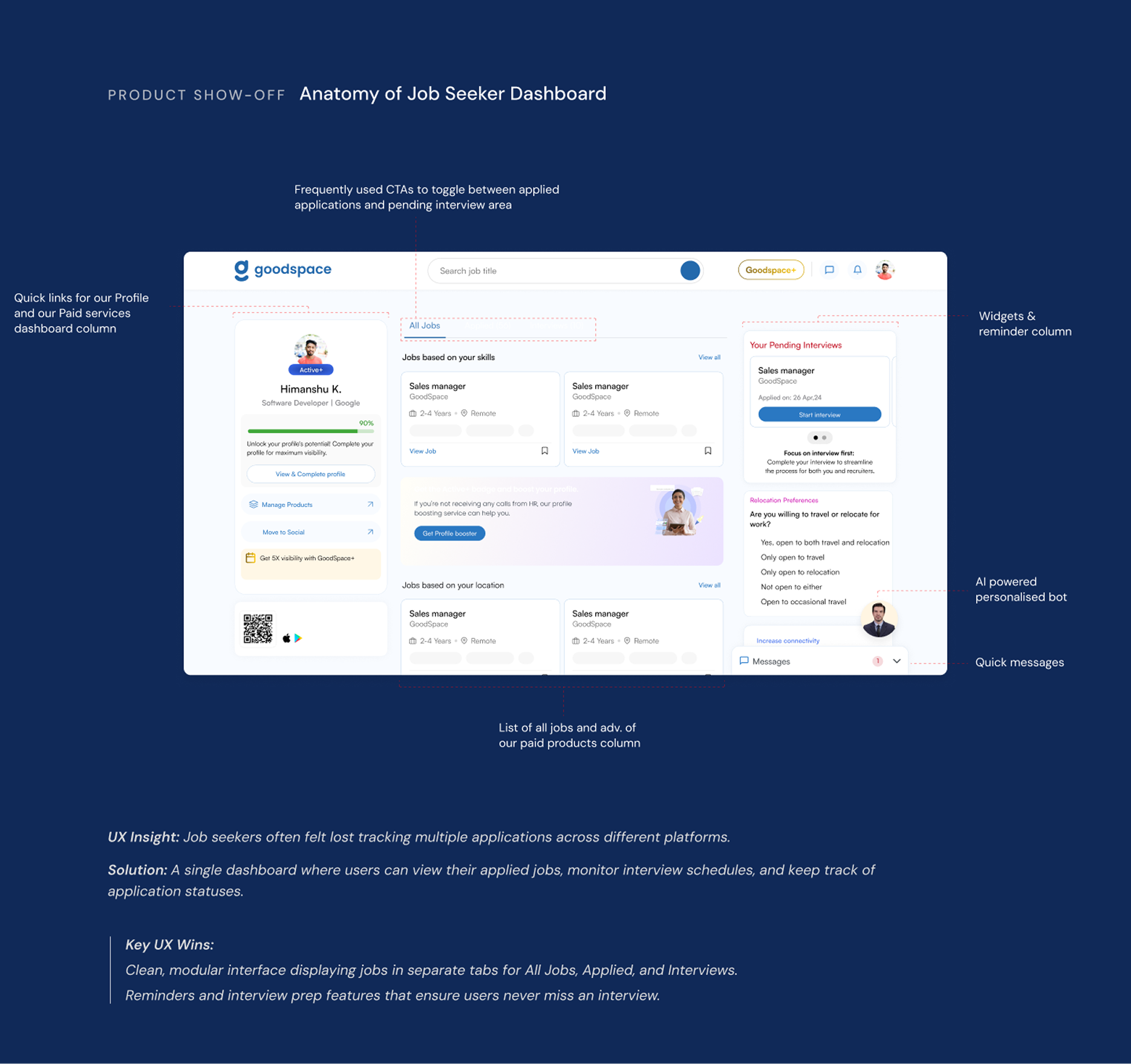
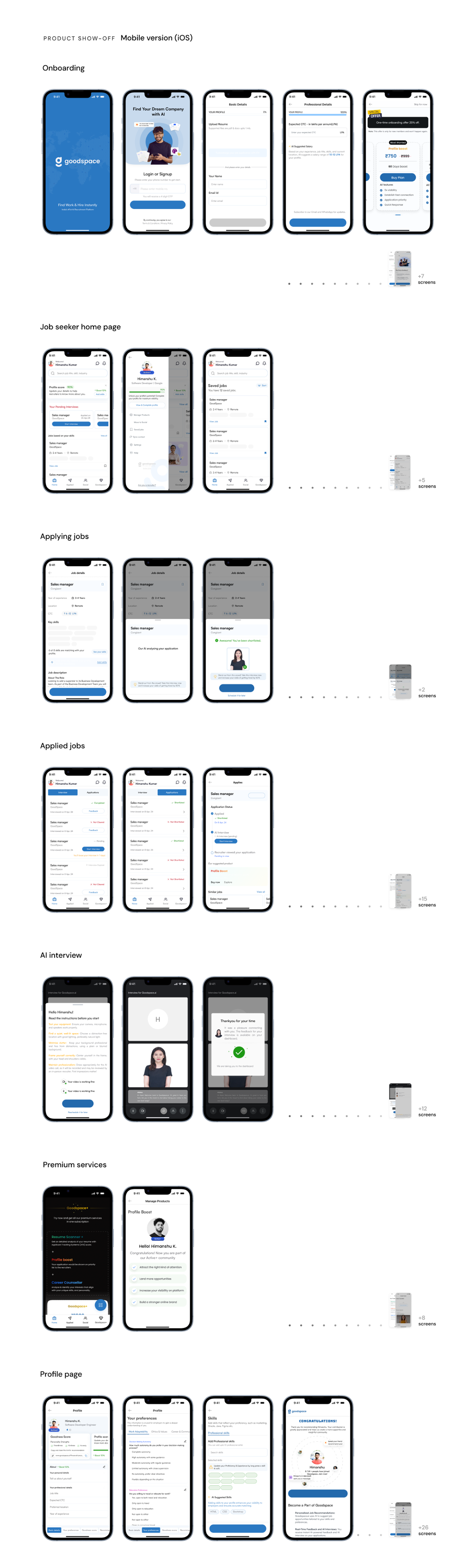
Instead of overwhelming users with options, we introduced personalized job recommendations with visible skill match indicators. This helped users quickly understand their fit for a role and reduced irrelevant applications.
2. Evaluation → AI Shortlisting
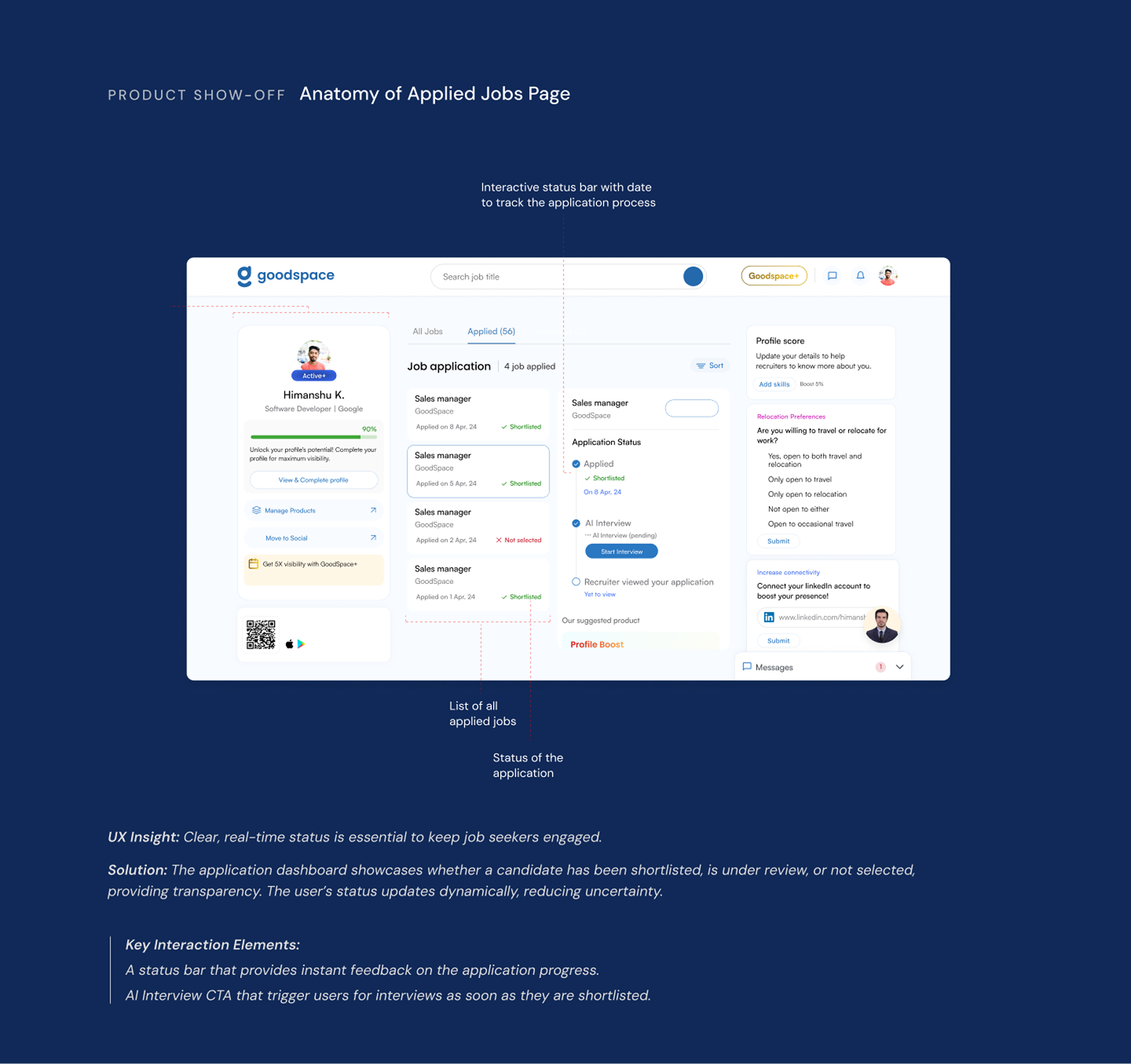
Applications were evaluated instantly using AI, removing the need for manual filtering. Users could now clearly see their application status — whether they were shortlisted, under review, or rejected — reducing uncertainty significantly.
3. Decision → AI Interviews
Shortlisted candidates could proceed directly to AI-powered interviews that took around 10–15 minutes. The experience was designed to feel conversational, with clear instructions and the ability to reschedule if needed.
System Thinking
Rather than treating each feature independently, the platform was designed as a connected system:
- Better matching → fewer irrelevant applications
- Faster shortlisting → reduced recruiter workload
- Structured interviews → quicker hiring decisions
This created a reinforcing loop where improving one stage strengthened the entire system.
Impact
After rollout, the impact was visible across key metrics.
The overall hiring process became significantly faster, with a 47% reduction in time required from application to interview completion.
User engagement also improved, with an 8% increase in application interactions, indicating that users were more confident in the process.
Most importantly, drop-offs decreased by 12%, showing that reducing uncertainty had a direct impact on user retention.
Reflection
This project shifted my approach from designing individual flows to designing systems that enable better decisions.
I learned that:
- AI features require transparency to build trust
- Reducing uncertainty has more impact than adding features
- Good systems improve both user experience and business efficiency
If I were to take this further, I would focus on improving AI explainability and making the system more adaptive to different user behaviors.